Feel free to email the Sheffield office anytime.
We're happy to help with any queries you have.
Sheffield makes things. It has made things for centuries — knives and swords and tools and cutlery and, since 1913, the steel that does not rust. The city's identity was forged in fire and grinding wheels long before it found other ways to express itself, and even now, when the old steelworks have become apartments and innovation districts, the underlying character remains: precise, self-reliant, not easily impressed, and sharper than most places give it credit for.
In 1913, a Sheffield metallurgist named Harry Brearley was attempting to develop a more erosion-resistant steel for gun barrels when he noticed that a sample containing chromium had not rusted after months in the laboratory. He had discovered stainless steel — though the name was given by a Sheffield cutler named Ernest Stuart, who recognised its commercial potential for cutlery immediately. The patent disputes that followed were messy, but the result was a material that is now everywhere: in surgical instruments, kitchen knives, aircraft components, architecture, and a thousand industrial applications that Brearley could not have foreseen. It started on a workbench in Sheffield.
Sheffield's relationship with steel was not simply economic. It was cultural. The city's skilled craftspeople — the little mesters, who leased grinding wheels and forge spaces to produce specialised metal goods — operated a system of craft independence that was unusual in the industrial age. Many of Sheffield's distinctive trades survived precisely because they required the kind of individual skill that could not easily be mechanised or consolidated.
Sheffield has always been argumentative, in the best sense. The city was an early centre of the Chartist movement in the 1830s and 1840s — the campaign for universal male suffrage and parliamentary reform that mobilised working-class political consciousness across Britain. Sheffield's radical tradition ran deep: Edward Carpenter, who settled in Millthorpe just outside the city in 1883, was a poet, philosopher, and early advocate of socialism, women's rights, and what we would now call LGBTQ+ equality. His writing influenced Gandhi, E.M. Forster, and a generation of reformers. He lived quietly, grew his own food, and kept making sandals by hand, but his ideas travelled far.
The Sheffield Outrages of the 1860s — a series of attacks by trade unionists against non-union workers — contributed directly to the Royal Commission that led to the legalisation of trade unions in 1871. Sheffield's workers were not patient about their rights.
In 1971, Sheffield opened a new theatre in the former library on Norfolk Street: the Crucible. Within a decade it had established itself as one of the finest studio and main-house theatres in Britain. In 1977, it became the permanent home of the World Snooker Championship — a relationship that has continued ever since, making the Crucible the most recognisable snooker venue in the world and giving Sheffield a global audience every spring. It is, in its own way, a very Sheffield thing: a serious cultural institution that also holds one of the most-watched sporting events on British television.
The Human League formed in Sheffield in 1977 and helped define synth-pop as a genre. Pulp — fronted by Jarvis Cocker, who grew up in the city's working-class suburbs and documented them with forensic wit — emerged in the 1980s and produced Different Class (1995), one of the defining albums of the decade. The Arctic Monkeys, four school friends from High Green in the city's north, released Whatever People Say I Am, That's What I'm Not in 2006; it remains the fastest-selling debut album in British chart history. Sheffield has produced more musically significant acts per capita than almost any British city — and done so with minimal industry support, on the strength of geography, friendship, and self-belief.
The Leadmill, opened in 1980, was the independent venue where much of this music was first performed. It remains open, despite legal battles over its tenancy in recent years.
Sheffield is, by area, the most forested major city in Europe — a geographical distinction that reflects its unique landscape of hills, valleys, and the greenbelt that wraps around the built environment. The Peak District begins at the city's edge; you can walk from the University of Sheffield into moorland within an hour. That combination of urban density and immediate countryside is one of Sheffield's most unusual and undervalued qualities.
The Advanced Manufacturing Research Centre at Catcliffe is one of the most significant industrial research facilities in Europe, working with Boeing, Rolls-Royce, and hundreds of smaller companies on the processes that will define advanced manufacturing for decades. The little mesters would have approved.
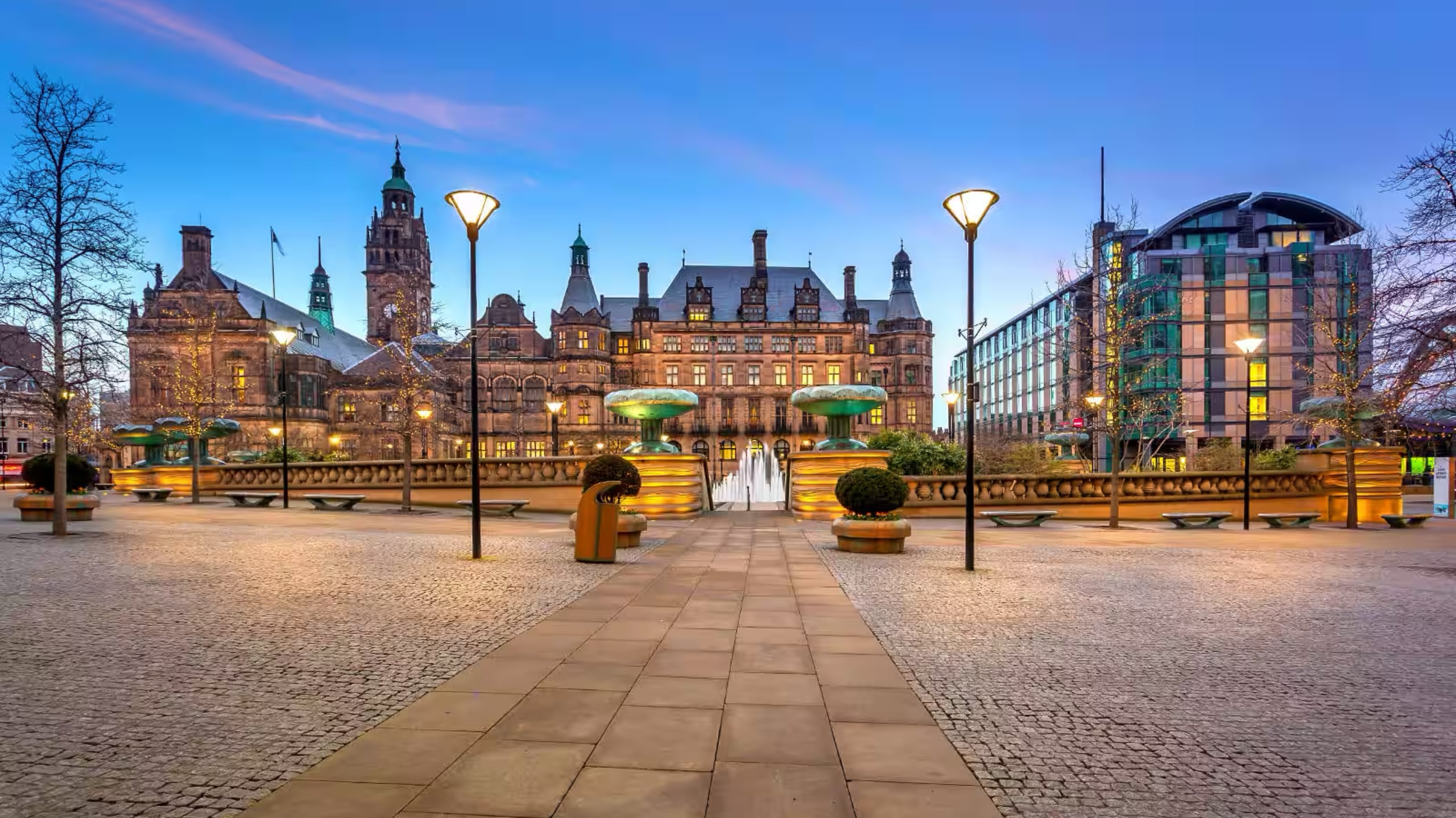
Photo by Benjamin Elliott on Unsplash