Loading seminars…
We couldn't load the seminars just now. Please contact us or try again shortly.
We don't have any Seminars available in Newcastle right now. Apologies.
Feel free to email the Newcastle office anytime.
We're happy to help with any queries you have.
Stand on the Tyne Bridge and look downstream. Seven bridges cross the river within a mile of each other, each one a different era of engineering ambition: the Swing Bridge of 1876, the High Level of Robert Stephenson, the Tyne Bridge itself — opened in 1928, the largest single-span bridge in the world at the time, and still one of the most recognisable structures in Britain. That view tells you most of what you need to know about Newcastle: a city that built things to last, built them beautifully, and understood that infrastructure is not merely functional but expressive of what a city thinks of itself.
Robert Stephenson — son of George, and arguably the more complete engineer — was born in Northumberland and worked from Newcastle. The Rocket, which won the Rainhill Trials in 1829 and proved that steam locomotion was commercially viable, was built in Newcastle. The Robert Stephenson and Company works on South Street produced hundreds of locomotives that were exported across the world, building railways in Egypt, Spain, and South America. Newcastle did not merely participate in the railway age; it manufactured the machines that made it possible. When you trace the global spread of the Victorian railway network, a remarkable number of threads lead back to a workshop on the Tyne.
In the 1830s and 1840s, Richard Grainger — a speculative builder of visionary ambition — remodelled the centre of Newcastle on a scale that few British cities have matched before or since. Working with the architect John Dobson and the town clerk John Clayton, Grainger created Grey Street, Grainger Street, and the Market — a planned Georgian and early Victorian city centre of colonnaded facades, sweeping curves, and consistent grandeur. Grey Street was voted the finest street in Britain in a BBC poll in 2005; it regularly appears on lists of the most beautiful streets in Europe. Newcastle's city centre is not a Victorian relic; it is a Victorian achievement, still functioning as its designers intended.
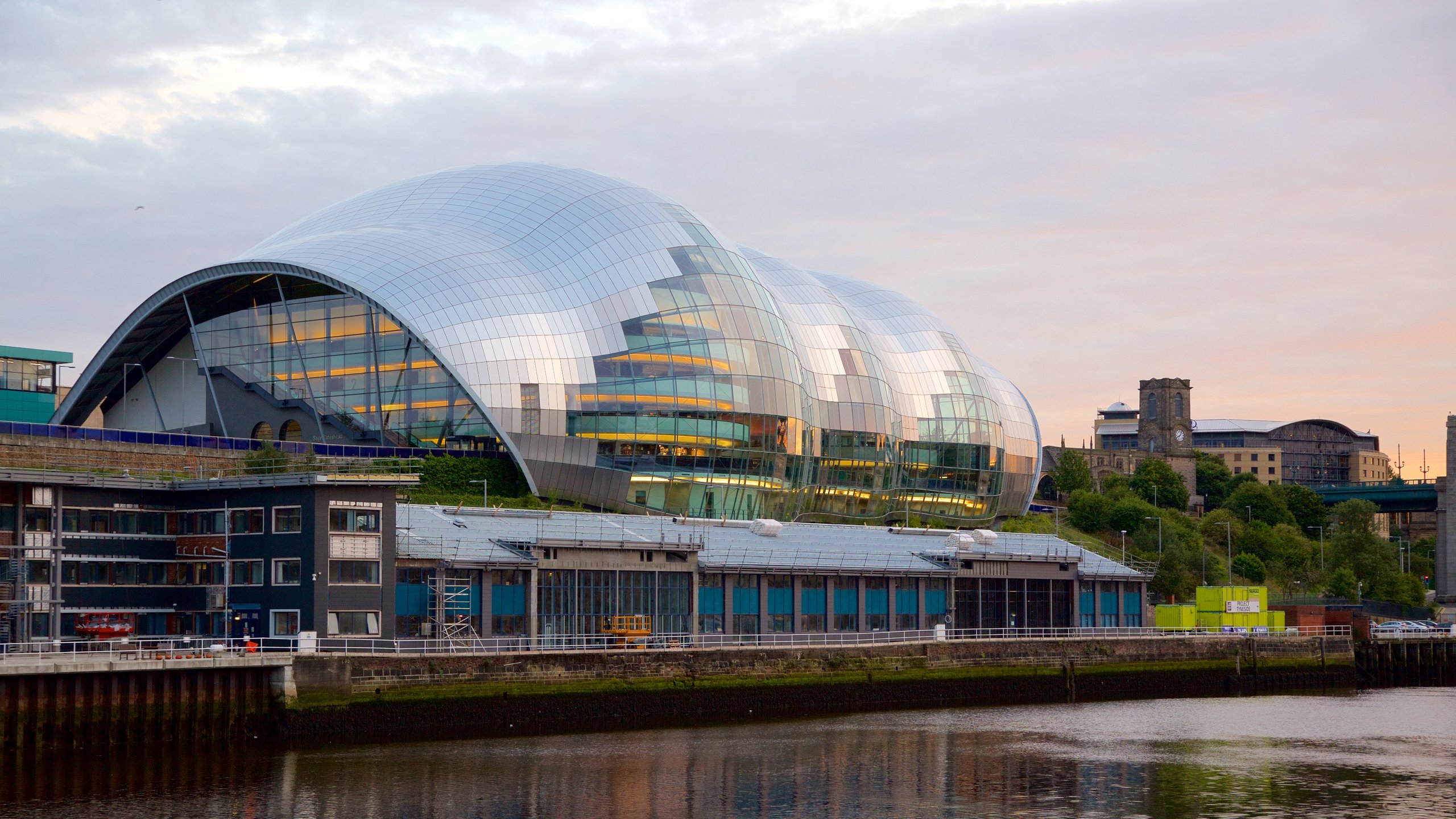
Newcastle's shipyards once launched vessels that crossed every ocean. By the 1980s, they were largely gone — the most dramatic deindustrialisation of any major British city. What followed was slower and harder than the mythology sometimes suggests, but the outcome is remarkable. The Gateshead Millennium Bridge, completed in 2001, is a tilting pedestrian bridge that has become an icon. The BALTIC Centre for Contemporary Art, opened in 2002 in a converted flour mill on the Gateshead bank, is one of the most significant contemporary art spaces in Britain. The Sage Gateshead — now known as the Glasshouse — opened in 2004 as a performance venue of genuine architectural distinction, designed by Norman Foster, home to the Royal Northern Sinfonia. The Quayside on both banks has been transformed into a cultural destination that would have been unimaginable to the men who worked the shipyards.
Newcastle University and Northumbria University together educate around 60,000 students and anchor an economy that has diversified substantially from its industrial roots. The Newcastle Helix development — a 24-acre innovation district between the universities and the city centre — brings together research, business, and housing on a former industrial site, with a particular focus on urban innovation, health sciences, and data. It is the kind of development that requires patience as well as ambition, and Newcastle has both.
The city's life sciences sector is growing, with particular strengths in ageing, genomics, and regenerative medicine. The population it serves is the right research population: the North East has high rates of the conditions that these fields address, creating both the clinical need and the research base in the same place.
Newcastle's social character is harder to quantify but not hard to feel. The Geordie identity — warm, direct, fiercely local, not easily impressed by anything that arrives claiming to be important — is one of the most cohesive in urban Britain. The city's pride in itself is not defensive; it is the straightforward confidence of a place that has earned what it has through repeated difficult experience and come through it with its character intact.
The seven bridges still stand. The city keeps building.